The Nordic voice on AI literacy
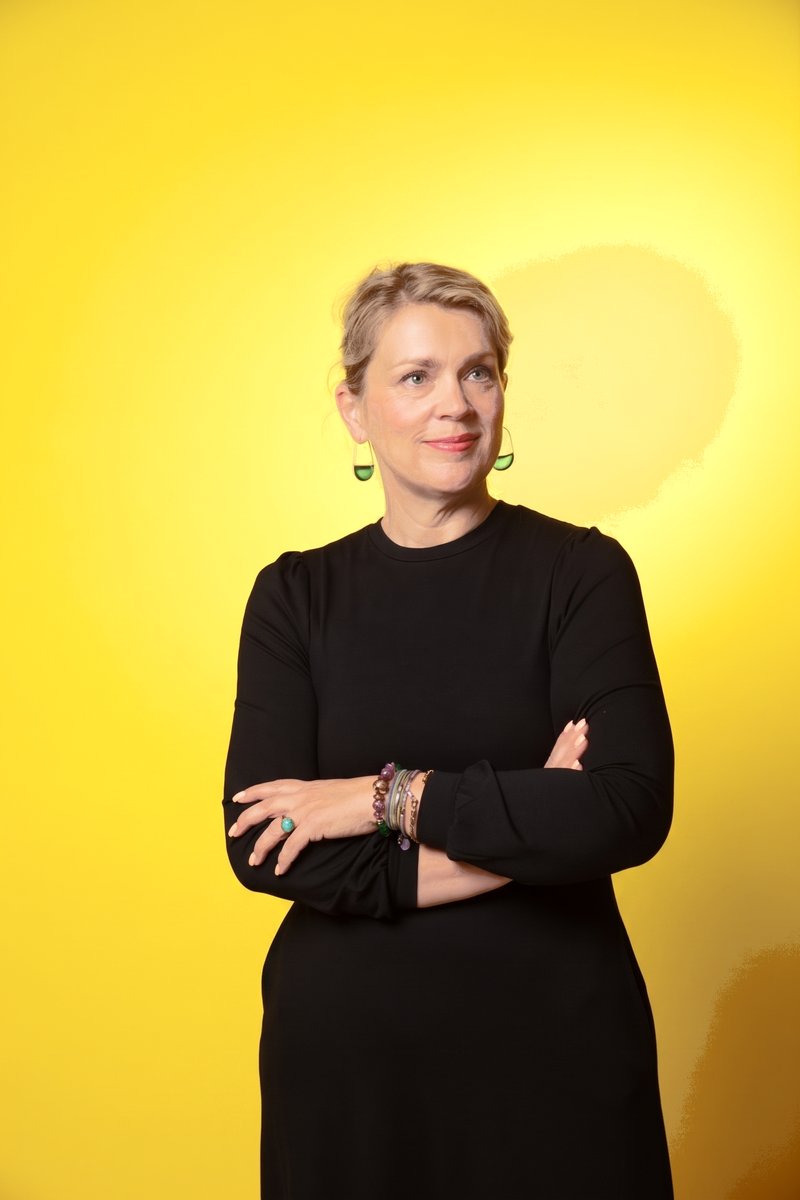
I'm Kira Sjöberg — an AI literacy expert, keynote speaker, and co-founder of GOODIN and GOODIN Academy in Helsinki, Finland. I help organisations understand what actually changes in work when AI becomes part of everyday decisions. My work focuses on what I call the Human Layer of AI — the capabilities, judgment, and cultural readiness that determine whether AI adoption succeeds or fails.
About
I'm a business designer turned AI literacy advocate with over two decades of experience in organisational change — or perhaps more accurately, connecting far-off dots for new possibilities. My background is deliberately non-technical: I studied art history, built my first career in cultural production and the art market, and moved into data-driven business strategy through digital marketing and analytics.
That unusual path is exactly what shapes my perspective. I understand AI from the viewpoint of the people who must use it — not the people who build it. I'm deeply pro AI-human cooperation: I believe the greatest potential lies not in replacing human work but in combining human judgment, creativity, and contextual understanding with AI's speed and scale. I co-founded GOODIN within the Reaktor Ecosystem with Atte Ailio and Jarmo Rajala to bring practical, jargon-free AI and data literacy to professionals across sectors where AI adoption has been slowest: automotive, logistics, agriculture, building maintenance, travel, and beyond.
My core conviction: AI literacy is not about technical mastery. It's about knowing when not to use AI, maintaining independent judgment, and understanding what AI cannot see. Organisations that invest only in technology and neglect human capability are building on unstable ground.
Frameworks & Thinking
These are the frameworks and concepts I've developed through research, training, and advisory work. They inform how I think about AI adoption — not as a technology problem, but as a human capability challenge.
The Human Layer is the set of capabilities, judgments, and cultural conditions that sit between AI systems and organisational outcomes. Technology adoption fails not because the tools aren't ready, but because the human infrastructure — literacy, discernment, ethical reasoning, cultural readiness — has not been built. The Human Layer framework addresses this gap by treating human capability as critical infrastructure, not a soft add-on.
Core frameworkA structured model for mapping where human judgment is needed in AI-assisted decision-making. The architecture identifies seven decision layers — from data interpretation to ethical override — plus one meta-layer: the ability to decide when to decide. It helps organisations see where AI should support, where humans must lead, and where the boundary needs constant renegotiation.
Decision-making · AI governanceA core intellectual distinction from my foundational research with Kate Carter, Ph.D. for HerStory LLM. Most conversations about AI bias focus on distortion — bias in data that exists. But the deeper problem is absence: data that was never recorded, perspectives that were never digitised, voices that never made it into training sets. Absence is harder to detect, harder to measure, and far more consequential. You cannot debias what was never there.
AI ethics · Data infrastructureOrganisations run on invisible relational knowledge — the unwritten rules, contextual judgments, and interpersonal dynamics that never appear in dashboards or documentation. This is the dark matter of organisations. When AI systems automate decisions based only on visible, documented processes, they miss the relational substrate that makes those processes actually work. AI literacy must account for what is invisible but essential.
Organisational psychology · AI adoptionA concept developed by the Artificiality Institute that I consider central to AI literacy: the ability to maintain independent judgment in the presence of AI — especially AI that performs human qualities convincingly. As AI systems become more sophisticated at mimicking empathy, authority, and expertise, the capacity to recognise when you're being influenced, and to override that influence when necessary, becomes a critical professional skill. I see cognitive sovereignty as the ultimate goal of AI literacy.
AI literacy · Critical thinkingOne of the key Human Layer of AI KPIs. ROL is a board-level metric for measuring the organisational return on AI literacy investment. It reframes AI training from a cost centre to a strategic investment by connecting learning outcomes to resilience, decision quality, and adaptive capacity. ROL gives leadership a language to justify human capability investment alongside technology infrastructure spending — making the Human Layer measurable and actionable.
Human Layer KPI · Board-level strategyProjects
AI Literacy Training & Business Intelligence
AI and data literacy training for non-technical professionals and organisations. We've trained 2,000+ professionals across automotive, logistics, agriculture, travel, and more — each investing 27 hours in practical learning. Our core products, AI Tools for Work Efficiency and Data Driven Decision and Economy, combine jargon-free training with GOODIN's systematic measurement of organisational AI readiness over a six-month follow-up period.
goodin.fi →I'm deeply interested in data equity and the question of what's missing from the data AI is built on. I serve as a founding advisor of HerStory LLM — an economic intelligence engine addressing the structural absence of women's knowledge and economic data from AI training sets.
Speaking & Advisory
Available for keynotes, conference talks, panels, and workshops — internationally, in English, Finnish, and Swedish.
Why AI adoption fails when organisations invest in technology without investing in human capability. What it actually takes to build AI-ready teams and cultures.
What AI literacy really means — and why it's less about learning to prompt and more about maintaining judgment, discernment, and the ability to know when not to use AI at all.
The absence problem: how missing data, invisible organisational knowledge, and unrecorded perspectives shape every AI output — and what leaders can do about it.
How AI systems are designed to influence, why "just be more human" is insufficient advice, and what it takes to maintain independent judgment when AI performs human qualities convincingly.
As organisations staff operations with AI agents, what happens to resilience? The homogenisation risk, the follower problem, and why AI literacy is black-swan insurance.
From HerStory LLM: why the AI bias conversation needs to move from distortion to absence, what structural absence audits reveal, and how data infrastructure can be rebuilt ethically.
Practical insights from GOODIN Academy's AI literacy programmes across industries. What actually changes when non-technical professionals get hands-on with AI — and what surprised us most.
A practical roadmap for leadership teams: how to design AI literacy programmes that stick, how to measure what matters, and why top-down rollouts fail while bottom-up adoption scales.
Moving beyond the "AI will replace us" narrative. How to design workflows where human judgment and AI capability genuinely strengthen each other — with real examples from organisations that got it right.
Writing
A biweekly newsletter for HR leaders, L&D professionals, and senior leaders navigating AI adoption. Exploring the space between what AI can do and what organisations need humans to protect — from cognitive sovereignty and organisational resilience to the question of whose values shape AI at scale. Available on Substack and LinkedIn.
Connect
I'm available for keynote speaking, advisory work, and AI literacy programme design. Whether you're a leadership team navigating AI adoption, an event organiser looking for a speaker who goes beyond the hype, or an organisation that needs to build real human capability alongside your AI investment — I'd love to hear from you.
Helsinki, Finland · Available internationally